Legal 500 is making client experience increasingly visible in its research and law firm profiles.
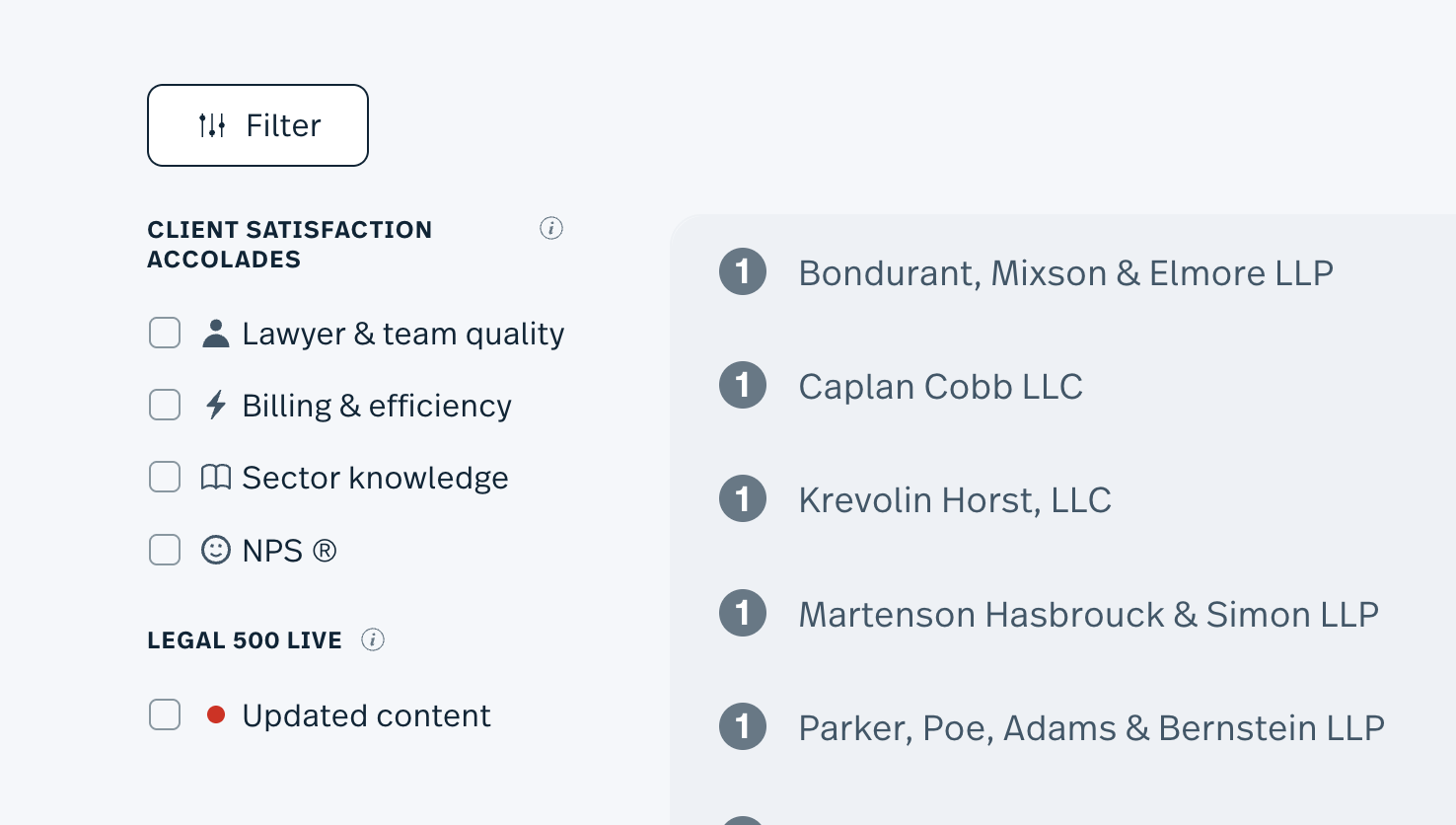
Alongside traditional rankings, firms may now receive Client Satisfaction accolades based on feedback collected from clients. The assessment covers four headline areas:
For law firms preparing Legal 500 submissions, this is an important development. Client feedback has always mattered, but it is now being analysed in a more structured and measurable way.
So what exactly do these indicators mean, how do they relate to rankings, and what should law firms do differently?
What is Legal 500 Client Satisfaction?
Legal 500 surveys hundreds of thousands of law firm clients each year and uses their feedback to assess client experience.
The current Client Satisfaction framework looks at four headline criteria. Legal 500 awards accolades to firms performing within the top 30% nationally for a particular criterion, subject to sufficient and valid data. The assessment is based on four years of consolidated referee data.
This means that a law firm may, for example, receive recognition for:
These accolades are already visible on Legal 500 firm and practice profiles.
What is NPS?
NPS stands for Net Promoter Score.
It is a widely used client experience metric based on one simple question:
How likely are you to recommend this law firm?
Clients answer on a scale from 0 to 10.
Their responses are then divided into three groups:
The NPS is calculated by subtracting the percentage of detractors from the percentage of promoters. Passives are not included in the calculation.
For example, if 70% of respondents are promoters and 10% are detractors, the firm’s NPS would be 60.
The important point is that NPS does not simply measure legal expertise.
A client may consider a lawyer technically excellent but still be reluctant to recommend the firm because of slow communication, unexpected fees, poor project management or insufficient commercial understanding.
That is why Legal 500 considers NPS alongside more detailed indicators of client experience.
What else does Legal 500 measure?
The Client Satisfaction assessment goes considerably deeper than a single recommendation score.
Lawyer and team quality includes:
Billing and efficiency includes:
Sector knowledge includes:
Together, these indicators create a much broader picture of how clients experience a law firm in practice.
A technically strong team may therefore perform differently depending on how accessible its partners are, how effectively matters are staffed, whether invoices are transparent and whether lawyers understand the commercial environment in which the client operates.
Does Client Satisfaction affect Legal 500 rankings?
Yes, but it is important not to overstate its role.
Legal 500 confirms that Client Satisfaction is one of a broad range of factors considered when making ranking decisions.
Other factors continue to include the complexity and significance of work completed, the strength of the practice, key individuals, peer feedback and client endorsements.
In other words, a strong NPS does not automatically produce a higher tier, and the absence of a Client Satisfaction accolade does not mean that a ranked firm provides poor client service.
The accolades sit alongside the editorial rankings and highlight firms with particularly strong client satisfaction results.
Why does this matter for Legal 500 submissions?
The biggest implication is for referee strategy.
Traditionally, some firms approached the referee list largely as supporting evidence for the submission: identify major clients, provide their contact details and hope that enough of them respond positively.
That approach is becoming less sufficient.
Client feedback now contributes to a structured dataset covering service quality, billing, efficiency, sector knowledge and willingness to recommend the firm.
This makes the quality of the referee pool more important.
A prestigious client name is useful, but the individual referee should also:
Legal 500 itself specifically notes that having responsive referees is important in creating a fair and accurate sample of a practice’s recent clients.
What should law firms do now?
First, review referee selection more carefully.
Do not select clients purely because their company name looks impressive in the submission. Consider the actual relationship between the referee and the team.
A client involved in a smaller but successful matter who knows the lawyers well may provide more useful feedback than a senior contact at a major corporation who had little direct involvement.
Second, look at client service before ranking season begins.
Questions worth asking internally include:
Are partners sufficiently accessible?
Are clients receiving timely updates?
Do invoices make sense to the client?
Is staffing proportionate to the work?
Do lawyers provide practical commercial advice rather than purely technical answers?
Does the team genuinely understand the client’s sector?
These are no longer only general client relationship questions. They closely reflect the areas Legal 500 is measuring.
Third, check referee data before submission.
Outdated email addresses, former employees and contacts who are unlikely to respond reduce the value of the referee list.
Legal 500 reports that it surveys more than 300,000 law firm clients annually, making client feedback a substantial part of its research dataset.
Fourth, do not coach clients on scores.
It is reasonable to tell clients that Legal 500 may contact them, explain the purpose of the research and confirm that their contact information is correct.
It is not good practice to tell referees how to rate the firm or suggest that they should give a particular score.
The purpose of the research is to capture independent client experience.
Can firms see their own Client Satisfaction data?
Legal 500 offers more detailed analysis through its Client Satisfaction KPI Reports.
These reports can benchmark a firm against market averages and selected competitors across areas including partner and associate quality, communication, billing transparency, efficiency, sector knowledge and NPS.
Legal 500 also offers its Client Experience Index, or CXI, which provides broader benchmarking and multi-year analysis of client experience.
Importantly, Legal 500 states that the CXI itself is a confidential reporting product and has no direct impact on rankings.
From client testimonials to measurable client experience
The broader direction is clear.
Legal directories are no longer looking only at what law firms say about themselves or which matters they handled. Client experience is becoming increasingly measurable.
Partner engagement, communication, billing, efficiency, commercial understanding and willingness to recommend a firm can now form part of a structured picture of how a practice performs from the client’s perspective.
For law firms, this means that Legal 500 preparation should not begin a few weeks before the submission deadline.
A strong submission still requires impressive matters, a credible team, clear market positioning and a well-prepared referee list.
But ranking performance is also influenced by something that cannot be written into a submission at the last minute: the experience clients have with the firm throughout the year.
Smartiee Agency supports law firms with Legal 500, Chambers, IFLR1000 and other international legal directory submissions — from practice analysis and matter selection to submission drafting, referee strategy and long-term rankings planning.
Alongside traditional rankings, firms may now receive Client Satisfaction accolades based on feedback collected from clients. The assessment covers four headline areas:
- Lawyer and team quality
- Billing and efficiency
- Sector knowledge
- Net Promoter Score (NPS)
For law firms preparing Legal 500 submissions, this is an important development. Client feedback has always mattered, but it is now being analysed in a more structured and measurable way.
So what exactly do these indicators mean, how do they relate to rankings, and what should law firms do differently?
What is Legal 500 Client Satisfaction?
Legal 500 surveys hundreds of thousands of law firm clients each year and uses their feedback to assess client experience.
The current Client Satisfaction framework looks at four headline criteria. Legal 500 awards accolades to firms performing within the top 30% nationally for a particular criterion, subject to sufficient and valid data. The assessment is based on four years of consolidated referee data.
This means that a law firm may, for example, receive recognition for:
- Client satisfaction: Lawyer & team quality
- Client satisfaction: Billing & efficiency
- Client satisfaction: Sector knowledge
- Client satisfaction: NPS
These accolades are already visible on Legal 500 firm and practice profiles.
What is NPS?
NPS stands for Net Promoter Score.
It is a widely used client experience metric based on one simple question:
How likely are you to recommend this law firm?
Clients answer on a scale from 0 to 10.
Their responses are then divided into three groups:
- 9–10: Promoters
- 7–8: Passives
- 0–6: Detractors
The NPS is calculated by subtracting the percentage of detractors from the percentage of promoters. Passives are not included in the calculation.
For example, if 70% of respondents are promoters and 10% are detractors, the firm’s NPS would be 60.
The important point is that NPS does not simply measure legal expertise.
A client may consider a lawyer technically excellent but still be reluctant to recommend the firm because of slow communication, unexpected fees, poor project management or insufficient commercial understanding.
That is why Legal 500 considers NPS alongside more detailed indicators of client experience.
What else does Legal 500 measure?
The Client Satisfaction assessment goes considerably deeper than a single recommendation score.
Lawyer and team quality includes:
- Partner availability and engagement
- Quality of partners
- Quality of associates
Billing and efficiency includes:
- Appropriate resourcing
- Efficiency in delivering legal services
- Billing transparency
- Value for work done
- Communication and case management
Sector knowledge includes:
- Profile in the sector
- Industry and commercial knowledge
Together, these indicators create a much broader picture of how clients experience a law firm in practice.
A technically strong team may therefore perform differently depending on how accessible its partners are, how effectively matters are staffed, whether invoices are transparent and whether lawyers understand the commercial environment in which the client operates.
Does Client Satisfaction affect Legal 500 rankings?
Yes, but it is important not to overstate its role.
Legal 500 confirms that Client Satisfaction is one of a broad range of factors considered when making ranking decisions.
Other factors continue to include the complexity and significance of work completed, the strength of the practice, key individuals, peer feedback and client endorsements.
In other words, a strong NPS does not automatically produce a higher tier, and the absence of a Client Satisfaction accolade does not mean that a ranked firm provides poor client service.
The accolades sit alongside the editorial rankings and highlight firms with particularly strong client satisfaction results.
Why does this matter for Legal 500 submissions?
The biggest implication is for referee strategy.
Traditionally, some firms approached the referee list largely as supporting evidence for the submission: identify major clients, provide their contact details and hope that enough of them respond positively.
That approach is becoming less sufficient.
Client feedback now contributes to a structured dataset covering service quality, billing, efficiency, sector knowledge and willingness to recommend the firm.
This makes the quality of the referee pool more important.
A prestigious client name is useful, but the individual referee should also:
- have recent and meaningful experience working with the team;
- understand the lawyers’ contribution;
- be able to comment on the service provided;
- have an up-to-date email address;
- and, crucially, be likely to respond.
Legal 500 itself specifically notes that having responsive referees is important in creating a fair and accurate sample of a practice’s recent clients.
What should law firms do now?
First, review referee selection more carefully.
Do not select clients purely because their company name looks impressive in the submission. Consider the actual relationship between the referee and the team.
A client involved in a smaller but successful matter who knows the lawyers well may provide more useful feedback than a senior contact at a major corporation who had little direct involvement.
Second, look at client service before ranking season begins.
Questions worth asking internally include:
Are partners sufficiently accessible?
Are clients receiving timely updates?
Do invoices make sense to the client?
Is staffing proportionate to the work?
Do lawyers provide practical commercial advice rather than purely technical answers?
Does the team genuinely understand the client’s sector?
These are no longer only general client relationship questions. They closely reflect the areas Legal 500 is measuring.
Third, check referee data before submission.
Outdated email addresses, former employees and contacts who are unlikely to respond reduce the value of the referee list.
Legal 500 reports that it surveys more than 300,000 law firm clients annually, making client feedback a substantial part of its research dataset.
Fourth, do not coach clients on scores.
It is reasonable to tell clients that Legal 500 may contact them, explain the purpose of the research and confirm that their contact information is correct.
It is not good practice to tell referees how to rate the firm or suggest that they should give a particular score.
The purpose of the research is to capture independent client experience.
Can firms see their own Client Satisfaction data?
Legal 500 offers more detailed analysis through its Client Satisfaction KPI Reports.
These reports can benchmark a firm against market averages and selected competitors across areas including partner and associate quality, communication, billing transparency, efficiency, sector knowledge and NPS.
Legal 500 also offers its Client Experience Index, or CXI, which provides broader benchmarking and multi-year analysis of client experience.
Importantly, Legal 500 states that the CXI itself is a confidential reporting product and has no direct impact on rankings.
From client testimonials to measurable client experience
The broader direction is clear.
Legal directories are no longer looking only at what law firms say about themselves or which matters they handled. Client experience is becoming increasingly measurable.
Partner engagement, communication, billing, efficiency, commercial understanding and willingness to recommend a firm can now form part of a structured picture of how a practice performs from the client’s perspective.
For law firms, this means that Legal 500 preparation should not begin a few weeks before the submission deadline.
A strong submission still requires impressive matters, a credible team, clear market positioning and a well-prepared referee list.
But ranking performance is also influenced by something that cannot be written into a submission at the last minute: the experience clients have with the firm throughout the year.
Smartiee Agency supports law firms with Legal 500, Chambers, IFLR1000 and other international legal directory submissions — from practice analysis and matter selection to submission drafting, referee strategy and long-term rankings planning.